September 30, 2026
The Panels Never Move. A Drum Full of Holes Spins Past Them, and the Picture Grows a Third Dimension.
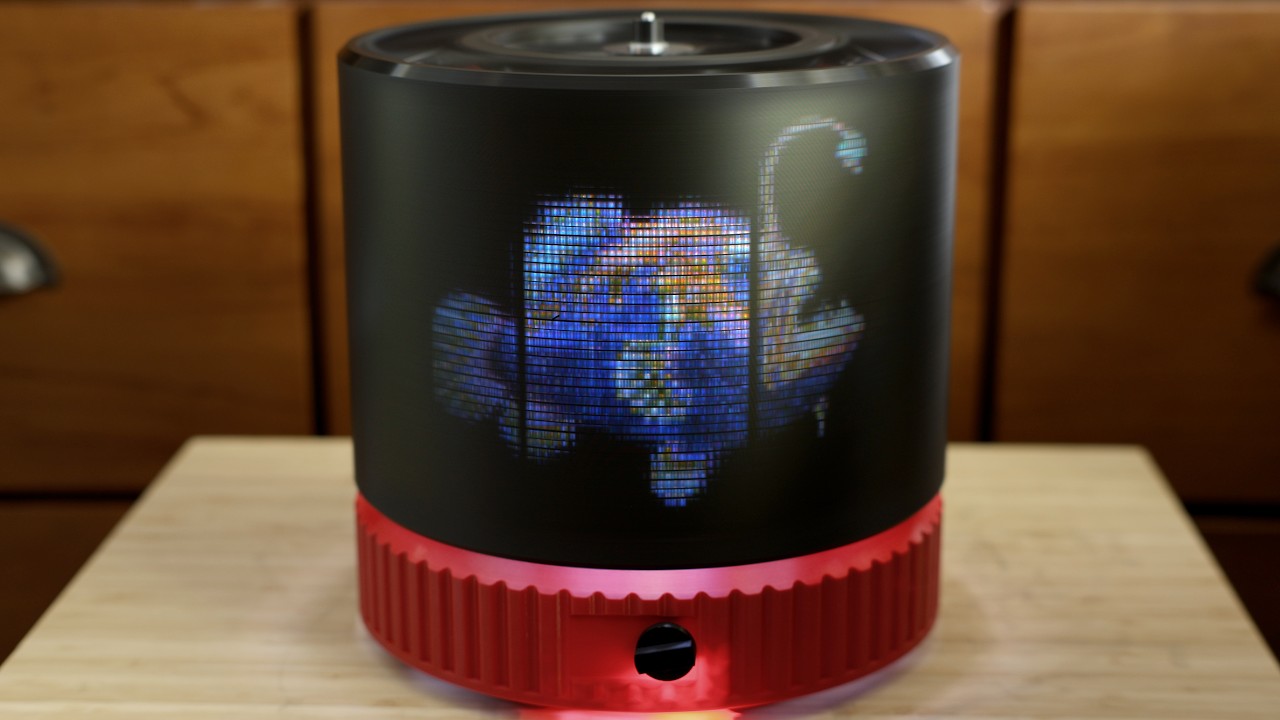
A maker who posts as AncientJames has built a three-dimensional display out of the oldest television idea on record. Hackaday's Tyler August covered it on 29 September: a rapidly spinning drum punched with holes, three LED matrix panels sitting still behind it, and a light-field image you can move your head around. It plays DOOM, because of course it does.
Mechanical television, the 1920s version, drew a picture by spinning a disc of holes in front of a single lamp and letting persistence of vision knit the dots into a frame. This build keeps the spinning holes and swaps the lamp for three 64 by 32 LED matrices arranged as half of a hexagonal prism. The work is in the software. The 3D model is rendered as a light field, meaning a set of views of the object from many angles, and each hole in the drum is fed the view that matches the angle it is passing through at that instant. Your two eyes look through different holes, receive different views, and your brain assembles depth without glasses or headsets. Effective resolution through the drum comes out near 100 by 48 pixels per eye. Three panels cover half a circle, so a full walk-around would need more of them. The panels never move and there is no laser projector, which is what makes this the most reachable of the several volumetric displays this maker has shown, after turns with mist, mirrors and bubbly glass. Think of it as a zoetrope that learned perspective.
This is the shift from maximum functionality to maximum well-being showing up in a display: a century-old scanning trick and hobby-shop LED panels produce an object no manufacturer sells, and one you could rebuild on a bench. Maybe this is what happens when someone stops asking what a screen can add and starts asking what a hole can take away. What if the display worth wanting turns out to be a drum, a motor, and a person willing to watch their fingers?