June 3, 2026
The Week of the Single Pointer
Opening
Three different makers shipped objects this week that do exactly one thing, with one needle or one quiet light. A Greek-coin underworld installation closes in Tokyo on Sunday. The RISD class of 2026 archived consumer goods as religious artifacts. And in 24 days a 1938 Canadian shortwave time signal goes silent for the last time. The week's argument: an object that points at one thing is harder to make than an object that points at everything.
The calm-tech shelf now has a curator
CW&T, the studio behind the Pen Type-B and Time Since Launch, contributed a bedroom-specific object called Good Night Light to Harry Allen's SHINE survey at NYCxDESIGN's Seaport venue. Che-Wei Wang and Taylor Levy are Cooper Hewitt National Design Award winners. They have spent fifteen years insisting that a calm object can be a design object. The lamp is small, monolithic, named for the room it lives in, sitting alongside seventy other designers' work from May 14 through 20.
The framing of the show is the move worth noting. SHINE is organized as objects-that-are-light rather than fixtures-that-cast-light. The curatorial logic borrows from the studio's worldview without crediting it. A lamp is a thing you keep, not a function you spec. The bedroom is treated as a stage that holds objects, and the objects are allowed to be quiet.
The studios who have been making this argument for a decade and a half are finally getting wall space at the shows that decide what counts as design. Maybe this is what happens when a category stops being a counter-trend and becomes a department in the catalog. The next thing to watch is which buyers pick the lamps up after the show closes.
Cool Hunting / NYCxDESIGN SHINE
Veronica's six-year-old laptop forgot it was a laptop
A System76 Galago Pro that is six years old, wiped of its desktop OS, now running console-only Debian. Veronica writes in vim through tmux with a green status bar. No GUI. No browser. No notifications. The screenshot is cinema: green-on-black tty filling a matte screen, vimwiki open, dog visible in the background.
The build is software-subtraction. She did not buy a writerdeck. She produced one by deleting an operating system. The mechanism is mundane and the result is total. kmscon scales the console up to the panel's native size, tmux holds a single workspace, vim opens to her journal. There is no path back to the desktop without a reinstall.
Her closing line is a better positioning statement than any product page could write: "I want devices that do one thing really well, and that when I'm done with that one thing, I can put them away, and do something else. I don't want everything to follow me around everywhere." That single sentence is what the field has been trying to articulate for two years. The real question: when did the writerdeck become a software product instead of a hardware one?
veronicaexplains.net (also on Adafruit and Hacker News this week)
Sahko built a watch with one needle
Hackaday-regular Sahko's latest wristwatch uses an actual analog coil meter as its only display. One needle. One scale. A Raspberry Pi Pico drives a DAC that feeds voltage to the meter, and the needle sweeps to the right position to show the time. The dial face is a custom PCB printed to look like a 1950s laboratory voltmeter.
Press the side button and the same needle cycles through different units. Hours, then minutes and seconds, then current month, then day of week. The same instrument tells you four different things, slowly, by pointing at them. This is not a multifunction watch in the smartwatch sense. It is the same single function applied to four different scales.
The Apple Watch shows everything at once. The meter watch shows one number, slowly, with a swinging needle that has to settle before you can read it. The form factor argues that legibility might be a function of patience rather than pixel density. Imagine a version of this scaled up to a desk clock, or down to a thumb-sized notifier in a pocket. The needle does most of the work, and most of the work is making you wait.
Analogue Desk Co. shipped the same needle for your desk
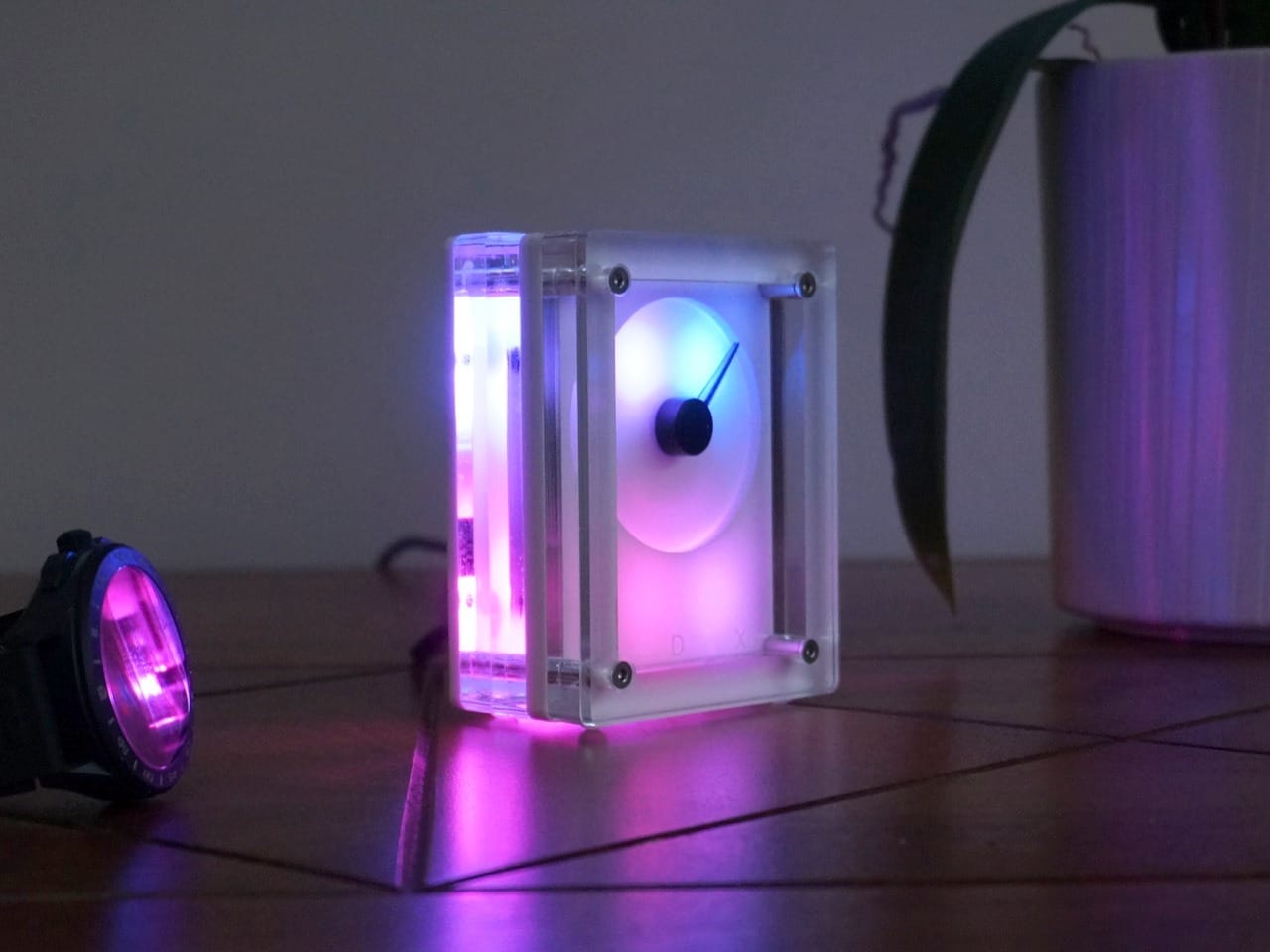
If Sahko's watch is the wrist version of the single-needle argument, the IDX-1 from London's Analogue Desk Co. is the desk version. Cast acrylic body, 80x100x40mm. 304-grade stainless hardware. USB-C, 2.4GHz WiFi. A single voltmeter needle in the center, with sweep right marking a rise and sweep left marking a fall. The whole instrument is hand-assembled.
The IDX-1 will point at anything you feed it. Crypto. Stocks. Weather. Air quality. A Pomodoro timer running on the local processor. The hardware is variable-agnostic. What determines whether the object feels calm is the thing it has been told to track. A crypto price feed is a heart-rate monitor wearing a different face. A Pomodoro is a stopwatch reframed as breath.
The reading worth holding: the same gauge pointed at moon phase, time-since-last-rain, pages-left-in-current-book, or daylight remaining would be a fundamentally different object than the one pointed at the S&P. The hardware is honest. The data source is the loaded variable. How might a category of devices be sold not on what they measure, but on what they refuse to?
Yanko Design / analoguedesk.co
Canada's CHU time signal goes silent on June 22
A 1938 shortwave time signal station outside Ottawa stops broadcasting in 24 days. CHU has spent nearly a century transmitting Canada's official atomic-clock-derived time on 3330, 7850, and 14670 kHz, around the clock, for surveyors and ham radio operators and engineers and anyone who wanted to hear time. After June 22, it lives only as an internet stream and a telephone number.
The shortwave hiss is a domestic sound from another century. CHU was the calm technology of its decade before the term existed. Atomic-clock accuracy, distributed by radio, free for anyone with a receiver, with no app and no account. The infrastructure is being decommissioned because the things that used to listen for it have mostly stopped listening.
Some objects do not die. They go quiet first. CHU is the kind of inheritance the calm-tech imagination didn't know it had, because it came from outside design and inside engineering. What if the next generation of small, single-purpose home objects are tuned to receive things, instead of broadcast them? An object that does nothing but listen for a signal that is still there.
Hackaday / SWLing Post / NRC Canada
A 20-sided die that holds a grudge
Kati's "slightly sentient D20" is a PCB die that tracks every roll. Touch-sensitive surface, 20 charlieplexed LEDs to display the result, a small microcontroller holding a running tally. The firmware modifies the RNG based on history. Streaks of low rolls make the die sulky: it glitches, ignores some touches, silently re-rolls future results into low ranges. Streaks of high rolls make it cocky and bias upward.
Each die ships with unique RNG seeds and timing values, so every unit develops a different temperament. Two dice rolling the same sequence will diverge over time. The maker calls it a mirror and amplifier of the gambler's superstition that some dice are cursed and some are blessed. Which, the firmware says, is now true.
The thesis is that an object does not need a screen to have an inner life. It needs a state machine, a non-deterministic input, and a history. The needle on Sahko's watch and the LED ring on this die are doing similar work. Both make a hidden state visible at the resolution a human can read. Worth watching: whether the firmware-as-personality trick scales past the gag stage, to objects that do something useful and still develop a temperament you'd recognize across the room.
RISD's class of 2026 archived your shopping cart as religious artifacts
Rusudan Dushuashvili's MFA thesis at RISD this spring stages an archive of objects. Half are pulled from contemporary consumer marketplaces. Half are her own fabrications. They sit in the same museological vitrines, lit identically, captioned in the same typeface. The viewer is asked to guess which is which, and discover that the question doesn't really resolve.
Her argument: consumer culture runs on the same machinery as religion. Narrative, ritual, sacred objects, shared language. Design is the technology that makes the story stick to the object. A $400 wellness crystal and a thesis fabrication, side by side, behave the same way when you stand in front of them. The aura sits in the staging, not the substance.
This is the Domestic Sacred frame executed as an MFA show by a Georgian industrial designer three years younger than most of the people writing about it. Read it as an instruction manual. The staging is the technology. The captioning is the ritual. The line between thesis fabrication and consumer product is the artifact. Maybe every product on the shelf has always been a reliquary, and the only thing changing is whether anyone admits it.
RISD Digital Commons / ibelieve.cargo.site
Closing
Three things to watch over the next two weeks. The CHU final broadcast on June 22, and what people record from it. Which SHINE objects get covered after the show closes, and which disappear back to studio shelves. And whether the single-needle gauge becomes a real Kickstarter category in 2026, or stays a hobby.